
The Science of Five Frequency Sound Healing


The use of five distinct frequencies as a foundation of sound healing work arose from multiple insights from a few distinguished individuals. As it developed across several decades, overlapping contributions of researchers working in medicine, acoustics, geometry, and philosophy added their own contribution.
The Origin of Five-Frequency Commutations
The most direct origin of the five-frequency model in sound healing is the work of Sir Dr. Peter Guy Manners (1902–2009), a British osteopath who devoted more than fifty years to investigating the therapeutic applications of sound. Manners’ foundational proposition was that every organ, tissue, and cell in the human body resonates at its own characteristic frequency, and that disruptions to those frequencies correspond to states of dysfunction or disease. His life’s work was directed toward identifying the precise frequency combinations that could restore biological resonance.
Dr. Peter Guy Manners begins the video "Bringing Matter to Life with Sound" by Hans Jenny, another sound researcher in the field.
Working alongside German and British scientists from the 1950s onward, Manners developed what he called commutations. These are carefully calibrated sets of five simultaneous frequencies. Each combination is designed to correspond to the resonant signature of a specific tissue or biological process, and the required set of five simultaneous tones was not an arbitrary distinction. Manners observed through clinical application that a single frequency, while capable of producing a response, was insufficiently stable and too specific for reliable therapeutic use. Two or three frequencies could produce interference patterns, which tend to have more impact on the tissue’s responsiveness. Two to three tones, however, lacked the structural complexity needed to sustain resonance within a biological system. Five frequencies, he found, produced a wave pattern that was both stable and rich enough in its harmonic content to entrain and therein positively change living tissue reliably.
These commutations became the basis of what Manners named Cymatic Therapy: the clinical application of sound frequencies to the body through vibrotactile and radiant means, with the intention of restoring the body’s own harmonic organization. Manners’ work remained largely outside mainstream medicine, but it attracted serious practitioners around the world and has continued to develop in the decades since his passing.
Wave Front BIOresonance
Dr. Gary Robert Buchanan, a composer, conductor, ordained minister, and researcher based in Nevada, began his formal engagement with vibrational healing in 1975. Over the following decades he developed Sonatherapy, which is a comprehensive healing framework integrating sound, light, color, water, and subtle energy therapeutics. In time, Buchanan emerged as one of the more rigorous practitioners working in the tradition of Manners’ Cymatic Therapy.
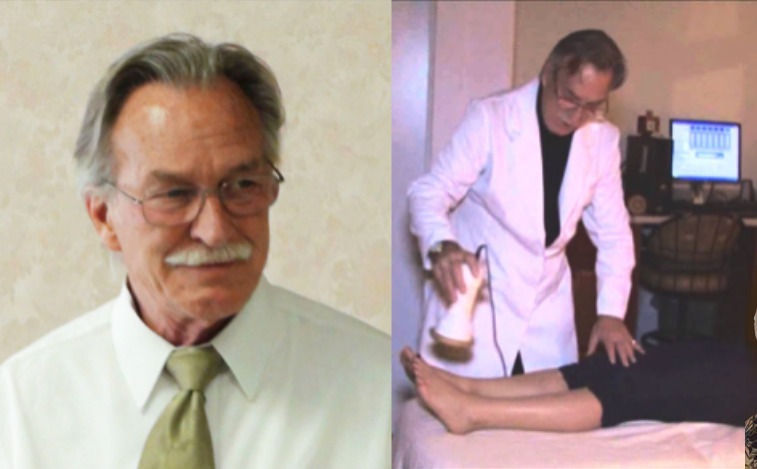
Dr. Gary Robert Buchanan shown using his BIOresonance apparatus with a patient.
In 2008, Dr. Buchanan published his landmark 502-page text, SONA: Healing with Wave Front BIOresonance, followed in 2012 by Sonatherapy: Healing with Light, Color, Sound, Water and Subtle Energies. These two volumes are now used as training texts for Sonatherapy practitioners on multiple continents. Buchanan’s particular contribution was to synthesize Manners’ clinical frequency research with a broader scientific and philosophical framework, drawing on cymatics, acoustics, the physics of water, and the geometry of natural systems.
Buchanan’s relationship with Manners was both personal and scholarly. In 2008, he traveled to Evesham, England, to meet with the aging Dr. Manners and present his research. Manners reviewed Buchanan’s work and responded directly: “Yes, this is exactly what needs to be done. I am pleased with where you are taking this technology,” before expressing his wish that Buchanan continue developing the cymatic healing tradition. Manners passed away the following year. From that point, Buchanan became one of the primary figures carrying the five-frequency therapeutic model forward.
In his research and published papers, Buchanan introduced the concept of Wave Front BIOresonance. This posits the idea that sound delivered as a structured multi-frequency wave front, particularly through the body’s visceral system of water, can restore and maintain the coherent bioresonance of living systems. He observed that sound travels approximately 4.3 times faster through water than through air, meaning that the body’s high water content makes it a particularly receptive medium for acoustic therapeutic work. The five-frequency commutation, delivered at the body’s surface and carried inward through tissue and fluid, produces what Buchanan describes as synergetic wave fronts. These are interference patterns with emergent properties that neither frequency alone, nor any smaller combination, would produce.
Buckminster Fuller and the Principle of Synergy
Buchanan’s use of the word “synergetic” is deliberate and carries a specific philosophical weight. It invokes the work of R. Buckminster Fuller (1895–1983), the American architect, systems theorist, and mathematician whose two-volume work Synergetics: Explorations in the Geometry of Thinking (1975 and 1979) established synergetics as a formal field of inquiry.

Buckminster Fuller holds a model of his "bucky ball" based on geometric configurations of stability and synergetics.
Fuller defined synergy as “the behavior of whole systems unpredicted by the behavior of their parts taken separately.” The principle is that a system, when its components interact, produces properties and behaviors that no individual component contains or implies. This became the cornerstone of his geometric and philosophical work wherein Fuller was explicit that nature operates synergetically at every scale. From the tensile properties of metallic alloys that exceed the summed strength of their constituent metals, to the structural behavior of geodesic forms that individual triangles cannot predict, synergetics are at play.
Fuller also proposed replacing the abstract mathematical concept of a straight line with wave phenomenon as the fundamental unit of description. He argued that all events in nature are wave-based rather than linear with frequency as a primary organizing principle.
For Fuller, the measure of how many times a pattern repeats within a system, and how that repetition generates stability, complexity, and emergent form is the intrinsic substrate of the fundamental.
Although not directly a researcher of sound healing, instead Fuller offered a comprehensive framework for understanding why interacting systems produce results that transcend their components. That framework maps naturally onto what Manners observed clinically and Buchanan has continued to develop theoretically. When five frequencies interact in a shared acoustic space, the wave patterns that emerge are not simply additive. They generate nodes and antinodes, constructive and destructive interference, regions of sustained oscillation and regions of stillness. The resulting field has a coherence and a complexity that none of the five frequencies would produce alone. This is synergy in the precise sense that Fuller described.
Cymatics: Visible Sound
The third foundational thread in this lineage is cymatics, which is the study of the physical, viewable patterns produced by sound vibrating in a medium. The field was named and systematically developed by Swiss scientist Hans Jenny (1904–1972), whose two-volume work Cymatics documented the fascinating geometric forms that appear on surfaces vibrated by sound. When a thin layer of sand, water, or fine powder is placed on plate that is made to vibrate, specific frequencies produce precise, consistent, and often beautiful patterns, such as concentric rings, star forms, grids, spirals, and shapes that echo the forms found throughout the natural world, such as like the microscopic radiolarian found in the sea.

Hans Jenny and cymatic representations as per solid substrates on Chladni plates and with vibrating sand. Fair use courtesy of Newcastle Herald.
Jenny’s work demonstrated that sound organizes matter. The patterns visible on a cymatics plate are not random as they are the standing wave patterns created by the interaction of the vibrating frequency with the boundaries of the medium. Through cymatics, the same physical phenomenon that produces the resonant nodes of a plucked string or a ringing bell can be made visible on a two-dimensional surface.
Buchanan has applied cymatic analysis directly to the healing commutations explored by Manners, observing the wave patterns produced when specific frequency combinations are introduced into drops of water. The forms that appear in those drops provide a visual record of the acoustic field being generated, and serve as one method of classifying and comparing different frequency combinations for their structural coherence and biological relevance. In Buchanan’s framework, the body’s high water content means that every therapeutic sound application is, in effect, a cymatic event occurring within living tissue.
How These Inform Sound Healing Practices
At Paths to Restoration, our five-gong wall brings these three lineages into a single acoustic space. The five-frequency model pioneered by Dr. Peter Guy Manners and extended by Dr. Gary Robert Buchanan provides the clinical and theoretical basis for understanding why five interacting frequencies matter. We are guided by their research to note that the minimum number found to produce a sufficiently complex and stable wave pattern for reliable biological entrainment is five. The synergetic principles articulated by Buckminster Fuller also provides the geometric and philosophical framework for understanding why five gongs sounding together produces an experience and a physiological effect genuinely beyond what any one gong produces alone. And cymatics provides the visual language for understanding what that acoustic field looks like when it encounters a medium, pattern and form.
Each of the five gongs on this wall contributes its own fundamental frequency. When they sound together, the interference patterns created between them generate a standing wave environment of considerable complexity, considering each gong alone has well over five frequencies that it is producing.
The body’s resonant systems can track, respond to, and, over the course of the eight-hour puja we provide, gradually align with those important systems. The healing that occurs in that alignment is not imposed from outside but is the body’s own intelligence, giving an acoustic field coherence that is gift enough to reflect its own deepest organizing frequencies, reflecting its capacity to heal back to itself.
Principal Sources and Attributions
Dr. Peter Guy Manners (1902–2009): Developer of Cymatic Therapy and the five-frequency commutation model. His decades of clinical research established the therapeutic foundation for multi-frequency sound healing.
Dr. Gary Robert Buchanan: Developer of Sonatherapy® and Wave Front BIOresonance™. Author of SONA: Healing with Wave Front BIOresonance (2008) and Sonatherapy®: Healing with Light, Color, Sound, Water and Subtle Energies (2012). Director of Wave Front BIOresonance Research, Steamboat Healing Center, Nevada.
R. Buckminster Fuller (1895–1983): Author of Synergetics: Explorations in the Geometry of Thinking (Macmillan, 1975) and Synergetics 2 (1979). His principle of synergy — that whole systems produce behaviors unpredicted by their parts — provides the philosophical and geometric framework within which multi-frequency acoustic fields are understood.
Hans Jenny (1904–1972): Swiss scientist and author of Cymatics. His systematic documentation of the physical patterns produced by vibrating sound laid the visual and scientific foundation for cymatic analysis in therapeutic practice.


Comments