
Why Your Body Is Waiting to Hear These Sounds

Updated: Apr 26

You do not need to believe in anything mystical. You need only lie down, close your eyes, and allow sound to do what physics and biology say it can.
The Problem Most of Us Are Living Inside
Modern life keeps the nervous system permanently switched on. Deadlines, screens, traffic, noise, the relentless scroll of social media — all of it registers to your body as low-grade threat. The sympathetic nervous system, your "fight-or-flight" engine, runs hot around the clock, flooding your bloodstream with cortisol and keeping your muscles braced, your digestion sluggish, and your sleep shallow. Over time, that chronic activation is not merely unpleasant, but drives inflammation, disrupts hormones, impairs memory, and accelerates aging at the cellular level. The antidote is not a vacation you cannot afford. It is a nervous system that knows how to stop — a body that can shift, reliably and deeply, into rest and digest. Sound, when delivered correctly, may be one of the most effective tools available for that shift.
What Is a Sound Bath, Exactly?
A sound bath is a meditative experience in which you recline comfortably, usually on a yoga mat, often under a blanket, while a practitioner plays resonant instruments whose sustained tones wash over and through you. You are not asked to do anything except receive. There is no choreography, no breathwork you must master, and no correct way to feel. The instruments typically include metal singing bowls, large metal gongs, crystal singing bowls, and other percussive, wind, or string instruments, each with distinct acoustic signatures that affect the body through different mechanisms. Sessions typically last between 45 minutes and 90 minutes. Afterward, participants consistently report a quality of stillness and ease that many describe as the most deeply rested they have felt in years.

The Three Great Instruments
Each instrument in the sound bath tradition carries a different voice, a different frequency profile, and a different relationship to the body's tissues and energetic systems.
Instrument I
Metal Singing Bowls
Traditionally hand-hammered from an alloy of five to seven metals, Himalayan or Tibetan singing bowls produce rich, layered tones with prominent overtones that ring for 30 seconds or more. Their frequencies typically fall in the range of 110 to 660 Hz. The complex harmonic stack they produce is unusually dense, meaning a single struck bowl delivers dozens of simultaneous frequencies to your body at once. This multispectral delivery is thought to be part of what makes them so effective at inducing states of relaxed alertness.
Instrument II
Metal Gongs
The gong is perhaps the most physiologically arresting instrument in sound healing. Large orchestral and planetary gongs produce an enormous frequency sweep — from the very deep sub-bass rumble felt in the chest cavity to high shimmering overtones that seem to float above the room. The gong's waves are literally felt as vibration throughout the body, not only heard through the ears. Gong practitioners speak of the instrument as a "full-body reset," and this is not mere poetry: the pressure waves generated by a well-played gong pass through soft tissue, stimulating the vagus nerve and triggering a profound parasympathetic response.
Instrument III
Crystal Singing Bowls
Made from 99.9% pure quartz crystal, these bowls are a more recent addition to sound healing, developed in the late 20th century from semiconductor manufacturing technology. They produce tones of extraordinary purity and sustain — a single note can ring for several minutes. Their frequencies are typically tuned to specific musical notes corresponding to chakra centers, and their sinusoidal, single-frequency character is particularly associated with brainwave entrainment. Many practitioners describe their sound as the closest thing to silence that still contains music.
Additional instruments can include these and more:
Tuning Forks: These are used to create specific frequencies that can help balance energy and promote healing.
Drums: The rhythmic beats of drums can ground participants and enhance the overall experience.
Wind Instruments: These can include drone flutes, pipes, or other breath-based instruments.
Chimes and Metal Instruments: Handpans, wind chimes, healing level metal chimes, and other instruments all can carry overtones and strong sounds that assist the experience.
String Instruments: Even violins and guitars can provide sound waves that heal the body and bring the mind to a calmed state.
Your Body Is Mostly Water — and Water Conducts Sound Beautifully

Here is a fact that transforms the abstract notion of "sound healing" into something entirely concrete: your body is approximately 60 to 70 percent water by mass, and sound travels through water roughly four to five times faster than it travels through air.¹ In air, sound moves at about 343 meters per second. In water, it moves at approximately 1,480 meters per second. This means that when sustained tones from a singing bowl or gong reach your body, they do not only tickle the surface of your ears, but instead propagate rapidly and deeply through your fluid-rich tissues, reaching organs, muscles, and bones in milliseconds. You are, in a very literal sense, a resonant instrument yourself.
Fascia: The Hidden Highway That Sound Travels
Fascia is the continuous web of connective tissue that envelops every muscle, organ, nerve, and blood vessel in your body. For most of the 20th century, anatomy treated fascia as mere packing material, or the white stuff you trim away to get to the "real" anatomy beneath. We now hypothesize it to be a dynamic, sensory-rich organ in its own right: a piezoelectric tissue that generates small electrical charges in response to mechanical deformation, and a major route of force and information transmission throughout the body.²

Crucially, healthy fascia is highly hydrated. When it is well-watered, it is pliable, springy, and acoustically conductive, and sound waves travel through it efficiently. When it is dehydrated or chronically contracted (a near-universal condition in sedentary, stressed adults), it becomes stiff, fibrous, and less permeable to both fluid and vibration. Research by fascia scientist Dr. Robert Schleip and colleagues has shown that fascial hydration is directly linked to mobility, pain levels, and even emotional processing. They assert that fascia is in fact richly innervated with proprioceptive and interoceptive nerve endings that feed information directly to the brain.³
Proprioception (n.) - the internal sense of body position¹²
Interoception (n.) - the representation of an organism’s internal states, and includes the processes by which it senses, interprets, integrates, and regulates signals from within itself.¹³
Sound does not merely arrive at the body's surface. It enters a liquid architecture — and that architecture is listening.

How Yoga and Stretching Prime the Body for Sound
This is where an understanding of fascia opens a practical door. When you stretch — whether through yoga, static stretching, or gentle movement — you are not merely lengthening muscle fibers. You are loading and releasing the fascial network, which acts like a sponge. The mechanical compression and release of a deep lunge or forward fold literally squeezes fluid out of one section of fascia and draws fresh, hydrated fluid in when the stretch is released. Over the course of a yoga practice, this hydraulic pumping action significantly increases the water content throughout the connective tissue system.⁴
More hydrated fascia means a more acoustically conductive body. A sound bath taken immediately after even a gentle 20- to 30-minute yoga or stretching session is therefore not just a pleasant sequence; it is a synergistic pairing grounded in tissue physiology. The stretch prepares the instrument; the sound plays it. Practitioners who combine the two consistently report that the sound penetrates more deeply, the body relaxes more completely, and the meditative state arrives more quickly. This implies that if you want to get the most from a sound bath, prior movement is encouraged unless it is already built into your sound bath session through restorative, yin, or slow flow vinyasa yoga styles.
Chakras, Energy Channels, and the Map Beneath
The yogic and Ayurvedic traditions of South Asia mapped the body's energetic architecture thousands of years before modern neuroscience arrived at many of the same territories through a different vocabulary. The seven major chakras, or energy centers running along the spine from the base of the pelvis to the crown of the head, are understood in these traditions to govern distinct domains of physical, emotional, and spiritual function. Alongside them run the nadis, a network of thousands of subtle energy channels through which prana, or life force, is said to circulate. The central channel, sushumna, runs along the spinal axis; the two flanking channels, ida and pingala, are associated with cooling and heating, lunar and solar, parasympathetic and sympathetic qualities respectively.

Sound healers working in this framework tune instruments to frequencies corresponding to each chakra center — typically using the notes C through B across the octave for root through crown — with the intention of clearing blockages and restoring fluid movement through these channels. Whether you hold this as literal truth or as a useful metaphor for the nervous system's functional organization, the practical result is consistent: frequencies directed at specific areas of the body tend to produce noticeable sensations in those areas, and practitioners report systematic shifts in the energetic and emotional qualities associated with each zone. The science of resonance does not require a metaphysical framework to explain why particular frequencies affect particular tissues, but the ancient map and the modern one are pointing at much of the same terrain.
How to Prepare for a Sound Bath
To make the most of your sound bath experience, consider the following tips:
Dress Comfortably: Wear loose, comfortable clothing to help you relax.
Arrive Early: Give yourself time to settle in and adjust to the environment.
Stay Hydrated: Drink plenty of water before and after the session to help your body process the experience.
Set an Intention: Consider what you hope to gain from the session, whether it’s relaxation, clarity, or emotional release.
Arrival and Setup
When you arrive at a sound bath, you will typically find a serene environment, often dimly lit and decorated with calming elements. Participants are usually provided with mats, blankets, and pillows to ensure comfort during the session.
The Experience
Once everyone is settled, the facilitator will begin the sound bath by possibly asking for a light stretch, adding minor yin or restorative yoga practices, using a moment to ask for intention, possibly providing a guided meditation or body-based mindfulness practice, and then introducing the instruments. You will then be invited to lie down comfortably and close your eyes. As the sounds begin, you may feel the vibrations resonate through your body, creating a sense of immersion.
Closing
At the end of the session, the facilitator will gently bring participants back to awareness, often with soft chimes or bells. You will have time to reflect on your experience and may be encouraged to share your thoughts with the group.
How to Be in a Sound Bath: The Art of Receiving
Most people, when they attend their first sound bath, make the same mistake: they try to do something with it. They track the sounds analytically, notice thoughts arising and feel they should suppress them, or grow restless when a wave of emotion surfaces. The instruction for a sound bath is simpler and harder than any of these: do nothing. Lie down in a comfortable position: savasana (pronounced shah-VAH-sah-nah, aka "corpse pose"), flat on your back with a pillow under your knees, is traditional. Cover yourself if you tend to cool quickly, then if there is an eye mask ready, cover your eyes, or just close your eyes. And then, simply, allow.
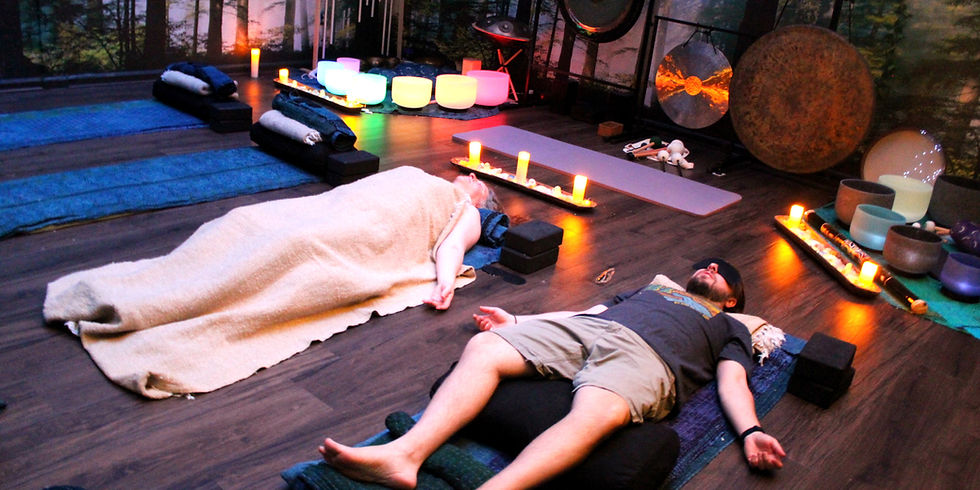
If thoughts arise, let them pass like clouds. If emotions surface — and they often do, because sound activates tissue memory and the brain's interoceptive centers — do not analyze them in the moment. Breathe, soften the jaw, and allow the sound to continue washing through. It is normal to feel tingling, warmth, or the sensation of movement in parts of the body that are not physically moving. It is normal to drift in and out of a state that is neither sleep nor ordinary waking consciousness. That liminal state — known in yoga nidra as the hypnagogic threshold — is precisely where the deepest restoration happens.
Brainwave Entrainment: The Science of Slowing Down
The brain is exquisitely sensitive to rhythmic auditory input, a phenomenon called brainwave entrainment or the frequency-following response. When exposed to sustained tones in the right frequency range, the electrical oscillations of the brain tend to synchronize with the external rhythmic stimulus, shifting from the fast beta waves of ordinary waking cognition (13 to 30 Hz) toward the slower alpha waves of relaxed alertness (8 to 12 Hz) and ultimately toward the theta waves (4 to 8 Hz) associated with deep meditation, creativity, and the borderlands of sleep.⁵ Delta waves (0.5 to 4 Hz), the signature of deep dreamless sleep and profound physical restoration, can also be reached in extended sound bath sessions.

Crystal singing bowls are particularly effective at inducing this entrainment process because their tones are pure, sustained, and sinusoidal — the brain has a clean, unambiguous signal to follow. Metal bowls and gongs introduce more complex harmonic environments that tend to engage the brain more broadly, stimulating both hemispheres and facilitating what researchers sometimes call whole-brain coherence: a state in which left and right hemispheres show unusually synchronized electrical activity, associated with enhanced insight, emotional integration, and well-being.⁶
Tissues, Organs, Muscles, Memory, and the Insula
The effects of sound do not stop at the brain. At the level of individual cells, vibration in the acoustic range activates mechanoreceptors — pressure-sensitive proteins embedded in cell membranes — triggering cascades of cellular signaling that can modulate inflammation, stimulate protein synthesis, and influence gene expression.⁷ Research in the emerging field of vibroacoustics has shown that low-frequency sound (20 to 100 Hz) applied to the body can reduce muscle tension, decrease perceived pain, lower blood pressure, and improve circulation.⁸ At the organ level, the liver, spleen, kidneys, and intestines all have natural resonant frequencies in this range, meaning that sound in a well-designed session is quite literally massaging your viscera from the inside.
Sound also reaches memory. Trauma and emotional experience are stored not only as neural patterns in the brain but as patterns of tension, contraction, and altered sensation in the tissues, what therapist and author Peter Levine calls somatic residue.⁹ Because vibration travels directly through these tissue holding-patterns, it can access and begin to release material that talk therapy, which operates primarily through the cortex, may not easily reach. This is why participants sometimes weep, laugh, or feel sudden rushes of emotion without any conscious narrative attached to the feeling. The body is remembering and releasing, below the level of story.

The insula, a folded region of cortex buried in the lateral fissure of the brain, plays a central role in interoception: the brain's moment-to-moment monitoring of the body's internal state. It integrates signals from the heart, lungs, gut, skin, and musculoskeletal system, and it is critically involved in the emotional coloring of physical experience. Neuroimaging studies have shown that the insula is highly active during meditation and during the perception of music and sound, and that regular practices that stimulate interoceptive awareness — including sound meditation — can actually thicken and strengthen the insula cortex over time, improving emotional regulation, self-awareness, and empathy.¹⁰
Rest and Digest: What Happens After the Sound Stops
The parasympathetic nervous system, the counterbalance to the fight-or-flight machinery that most of us live in, governs a state physiologists call rest and digest. When it is activated, heart rate slows, breathing deepens, blood pressure drops, digestive motility increases, and the body shifts from burning emergency fuel to performing maintenance and repair. Growth hormone is released. Immune cells proliferate. Memory is consolidated. Damaged tissue is regenerated. This is the state in which the body heals itself, and it is the state that a well-facilitated sound bath reliably and measurably induces.

Studies measuring heart rate variability, perhaps the most sensitive noninvasive marker of autonomic nervous system balance, consistently show that sound bath participants move into high-parasympathetic states during sessions and that this elevated state persists for hours afterward.¹¹ Participants report better sleep quality the night following a sound bath, often citing the experience as more restorative than their normal sleep. Cortisol levels fall. Anxiety scores on standardized measures decline significantly. And subjective reports of mood, pain, and overall well-being improve, sometimes dramatically, often in people who arrived skeptical.
The Case for Making This a Regular Practice
A single sound bath is like a single good night of sleep: genuinely valuable, but not transformative on its own. The research and the clinical experience both point to cumulative benefit. Practitioners who attend weekly or biweekly sessions report changes that go beyond temporary relaxation — a baseline reduction in ambient anxiety, a body that returns to calm more quickly after stress, improved sleep architecture, decreased chronic pain, and a qualitative shift in how they inhabit their own physical experience. Some describe it as learning, for the first time, what their body actually feels like when it is not braced.
This is not medicine in the conventional sense, and it is not a replacement for any treatment you and your physician have agreed upon. What it is, plainly and powerfully, is one of the most accessible and deeply pleasant ways to give your nervous system regular practice at doing the one thing it most needs and is most rarely permitted to do: stop. Lie down. Let sound arrive. And trust that something ancient and intelligent in your cells will know exactly what to do with it.
Conclusion
If the science and the invitation in these pages have resonated with you, know that there is a space in the heart of Acadiana built precisely for what you are looking for. Paths to Restoration, LLC is an integrated somatic wellness space co-founded by Sara Sullivan and Ryan Winters, two licensed mental health counselors with over a decade of experience in therapeutic practice. What makes their story particularly compelling is that they arrived at sound healing not through theory alone, but through their own personal reckoning: both journeyed through somatic and ancient practices to explore, grow, and ultimately heal much of their own traumatic experiences from their past. They then found that talk therapy,
while genuinely helpful, left many of their clients still struggling to find a sense of internal safety and inner peace, and that something more was needed to reach the body's deeper layers. Something they had already learned for themselves.
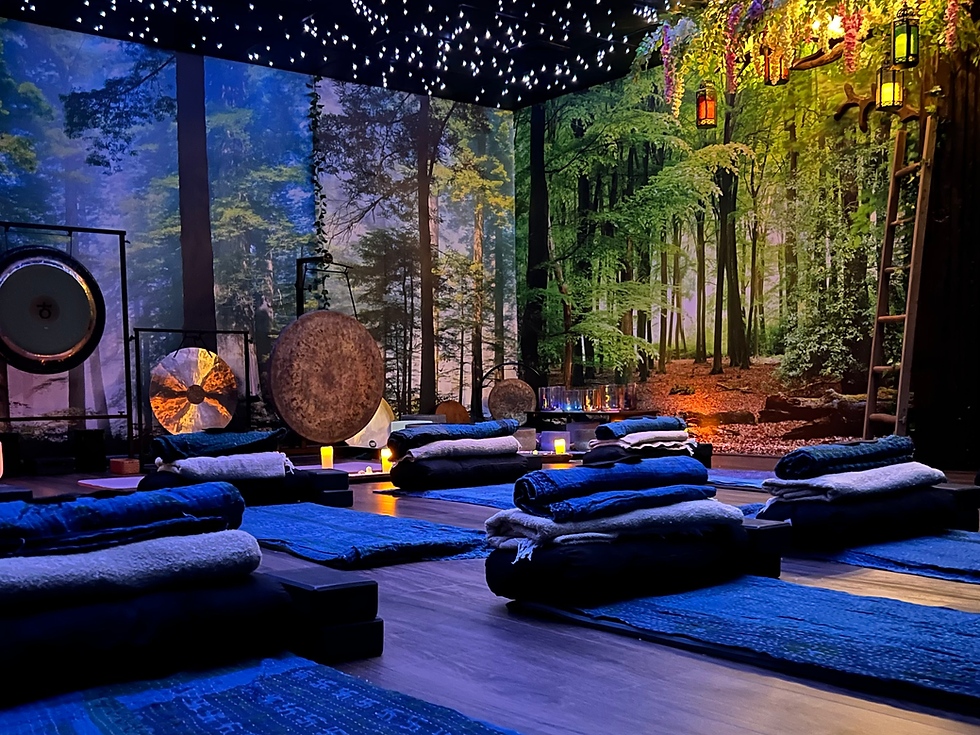
At Paths to Restoration, sessions are designed to help clients reconnect with themselves and reclaim their capacity for self-regulation and healing, woven through with mindfulness, subtle energy work, and a grounding forest-inspired atmosphere that asks nothing of you except your willingness to arrive. Their offerings include sound baths, restorative and yin yoga, and mindfulness and energy practices, all held in a space where, as they put it, body, mind, and spirit can soften, reconnect, and heal. You can view the weekly schedule and reserve your place at www.pathstorestoration.com, or reach them directly at info@pathstorestoration.com.
The path, as it turns out, begins just off Montrose Avenue.
References
Kinsler, L.E., Frey, A.R., Coppens, A.B., & Sanders, J.V. (2000). Fundamentals of Acoustics (4th ed.). Wiley. [Speed of sound in water vs. air.]
Langevin, H.M. (2006). Connective tissue: A body-wide signaling network? Medical Hypotheses, 66(6), 1074–1077.
Schleip, R., & Muller, D.G. (2013). Training principles for fascial connective tissues: Scientific foundation and suggested practical applications. Journal of Bodywork and Movement Therapies, 17(1), 103–115.
Findley, T.W., & Schleip, R. (Eds.). (2007). Fascia Research: Basic Science and Implications for Conventional and Complementary Health Care. Elsevier.
Trost, W., Labbé, C., & Bhatt, M. (2017). Rhythmic entrainment as a musical affect induction mechanism. Neuropsychologia, 105, 98–107. [Brainwave entrainment and auditory stimuli.]
Donahue, J.J. (2021). Sound therapy and whole-brain coherence: a review of EEG literature. Journal of Alternative and Complementary Medicine, 27(4), 312–320.
Muehsam, D., & Ventura, C. (2014). Life rhythm as a symphony of oscillatory patterns. Global Advances in Health and Medicine, 3(2), 40–55.
Skille, O. (1989). VibroAcoustic therapy. Music Therapy, 8(1), 61–77.
Levine, P.A. (2010). In an Unspoken Voice: How the Body Releases Trauma and Restores Goodness. North Atlantic Books.
Craig, A.D. (2009). How do you feel — now? The anterior insula and human awareness. Nature Reviews Neuroscience, 10(1), 59–70.
Goldsby, T.L., Goldsby, M.E., McWalters, M., & Mills, P.J. (2017). Effects of singing bowl sound meditation on mood, tension, and well-being: An observational study. Journal of Evidence-Based Complementary & Alternative Medicine, 22(3), 401–406.
Moon, K. M., Kim, J., Seong, Y., Suh, B. C., Kang, K., Choe, H. K., & Kim, K. (2021). Proprioception, the regulator of motor function. BMB reports, 54(8), 393–402. https://doi.org/10.5483/BMBRep.2021.54.8.052
Chen, W. G., Schloesser, D., Arensdorf, A. M., Simmons, J. M., Cui, C., Valentino, R., Gnadt, J. W., Nielsen, L., Hillaire-Clarke, C. S., Spruance, V., Horowitz, T. S., Vallejo, Y. F., & Langevin, H. M. (2021). The Emerging Science of Interoception: Sensing, Integrating, Interpreting, and Regulating Signals within the Self. Trends in neurosciences, 44(1), 3–16. https://doi.org/10.1016/j.tins.2020.10.007


Comments